

How to Prepare for Your 1st Model United Nations Conference
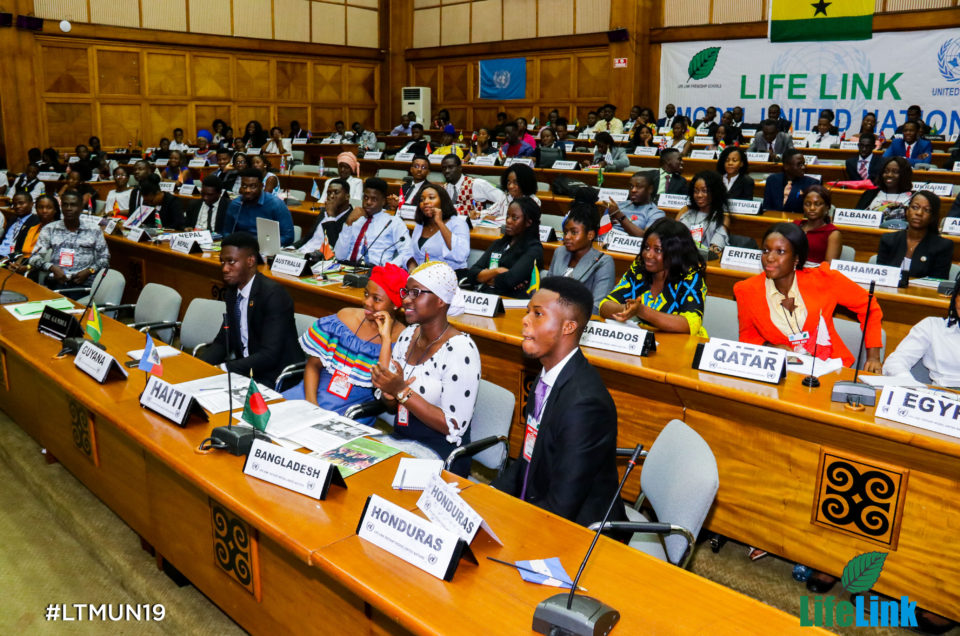
Your First MUN Can Feel Overwhelming — And That Is Completely Normal
Hi there, prospective delegate,
If you are reading this, you probably have heard of LTMUN and you are wondering what is it all about. You might be asking questions such as: “What is Model United Nations?” “Will I fit in as a first time delegate?” “What can I expect?”
The good news is you are not the only one.
Entering your first Model United Nations conference can be intimidating. You look around the room and see delegates confidently raising their placards, giving speeches and discussing global issues as if they’ve been doing it for years. It’s only natural to ask yourself: Am I ready enough? Will I understand the procedures? Will I even know what to say when it’s finally my turn to speak?
Those kinds of feelings are normal.
Every seasoned MUN delegate was once a first timer. Before they could be confident speakers and skilled negotiators, as was true of everyone else, they had to learn the procedures, the terminology, and their way around committee. Whether this is your first time attending Model United Nations or your first LTMUN conference, no one expects you to walk in knowing it all.
This article is not intended to teach you all the rules and procedures before conference day. Instead, it’s to help you get a grasp on what MUN is, what your first conference will likely be like, and how a little pre-conference prep can help you walk into committee informed, comfortable, and prepared to get the most out of the experience.
Understand How Model United Nations Actually Works
Before you start researching your country or writing your speeches you need to understand what Model United Nations is really about.
Model United Nations is a simulation of the United Nations in which students take on the role of delegates from different countries. But MUN is not just a matter of speeches and debating with other participants. It’s about diplomacy – understanding different points of view, negotiating with others and working together to come up with solutions to global challenges.
Your job as a delegate is not to express your personal opinions. Instead you are representing the position, interests and priorities of the country you have been assigned.
At a conference such as LTMUN, delegates discuss major global issues in various committees. Committees may address issues such as international security, public health, human rights, environmental problems or economic development. The aim of each committee is the same: to find practical answers through discussions, negotiations and cooperation, though the focus of each committee is different.
There are several stages to the typical committee meeting. Delegates will be able to give speeches to explain their country’s position, participate in moderated discussions about individual aspects of the topic, and participate in unmoderated caucuses where they negotiate and work with other delegates. These discussions ultimately result in draft resolutions – documents which set out proposed solutions to the issue being discussed.
MUN, like any new environment, has its own vocabulary. Terms such as Speaker’s List, Moderated Caucus, Unmoderated Caucus, Position Paper and Resolution may seem foreign at first, but understanding these basic concepts will make your first conference experience much easier.
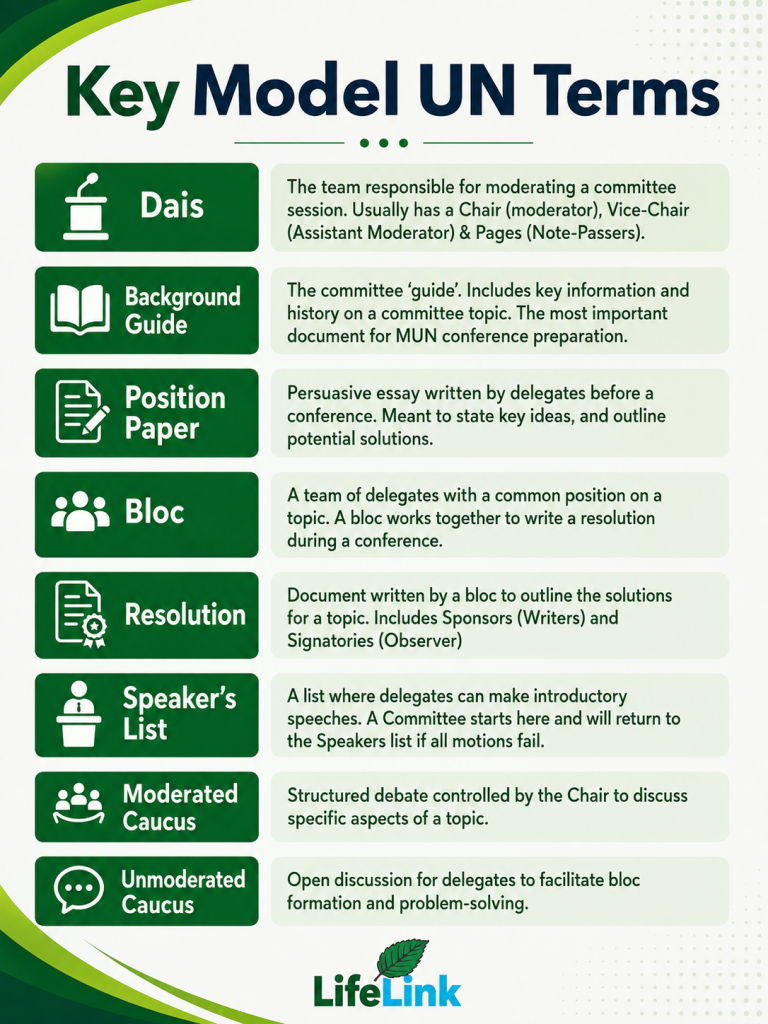
The procedures and terminology might be a little daunting for first-time delegates at the beginning. However, the process gets much easier once you experience it. You don’t need to know or memorise all the rules before you walk into the conference room.
Remember MUN is not about knowing everything on day one. It is about the willingness to learn, to engage and to adapt. Knowing the purpose of each stage of debate will make you a more confident and effective delegate.
Research Is the Foundation of a Successful MUN Experience
Research is one of the most important responsibilities of a delegate because every speech, negotiation, and proposed solution depends on how well you understand the issue being discussed. Confidence in MUN does not come from memorising impressive phrases — it comes from knowing your position and understanding why your country takes that position.
The first step in your preparation is understanding your assigned country. Remember, you don’t just speak for yourself, you speak for a country with its own history, interests, policies, and priorities.
Make an effort to get to know your country, discover your country’s:
- political leadership and system,
- development and economic priorities,
- foreign policies,
- international partnerships,
- before the discussion of the subject matter.
This will help you answer important questions:
- What would my country’s likely attitude be to this question?
- What solutions would my country support?
- What might be its limitations or concerns that guide its decisions?
When you have learned your country, the next move is to research on the agenda. The background guide of the conference should be your starting point. It introduces the topic, explains key issues, points to previous international actions and gives direction for what your committee will discuss.
But strong delegates go beyond the background guide. They consult reliable sources such as United Nations documents, government websites, official statements, research reports and reputable news organisations. It enables them to develop solutions that are both innovative and workable, and in line with their country’s interests.
Delegates should also know what their assigned committee is for. Different committees have different roles and restrictions. What works for one committee may not be appropriate for another. Knowing your committee enables you to provide practical and relevant ideas.
Delegates at LTMUN are required to write and submit position papers prior to the conference. A position paper is a paper that describes what position your assigned country has on the agenda, what actions have been taken previously and possible solutions to the issue being discussed. It’s more than a requirement, it helps you organise your research and set the scene for your participation during committee sessions.
Ultimately, good research is not about knowing every little detail about your topic. It’s about knowing your country’s point of view well, the issue at stake and what role you can play to find solutions.
Public Speaking and Participation: Finding Your Voice as a Delegate
For many first-time delegates, one of the most intimidating parts of Model United Nations is speaking before a committee.
You might fear messing up, forgetting your lines or being compared to delegates who look more experienced and confident. But every great speaker begins with their first speech, and confidence comes with preparation and practice.
In MUN public speaking is not about giving the most complicated speech or using the most impressive vocabulary. It’s about articulating your country’s position clearly, presenting your ideas well and contributing meaningfully to the discussion.
And one of the best ways to become a more confident speaker is to understand your research. If you understand your country’s position and the topic at hand, you are less likely to fall back on memorised speeches and more able to adapt to the flow of the debate.
It is useful to prepare an opening speech before the conference, introducing your country’s perspective on the agenda and highlighting the solutions you would like the committee to consider. But remember that MUN is a dynamic place. Discussions may take unexpected turns and you may need to respond to new arguments or ideas from other delegates.
It is important to participate in committee sessions. Ask questions, add to the discussions and don’t be afraid of making mistakes. Your first speech doesn’t have to be perfect, it just has to be your first step to becoming a better delegate.
Remember, the point of public speaking in MUN is not to put on a show for the room. It is to communicate, to collaborate, to represent your country well. The more you participate, the more comfortable you will become.
MUN Is More Than Debate: The Power of Diplomacy, Collaboration, and Growth
The first time students are introduced to Model United Nations, they often picture a room full of delegates giving powerful speeches and arguing with one another. Public speaking and debating are important aspects of MUN, but they are only part of the experience.
Fundamentally, MUN is all about diplomacy.
Countries don’t build real-world international relations by debating until one side concedes. They are built through discussion, negotiation, compromise and the discovery of solutions that can be supported by different parties. The idea behind the Model United Nations is the same . Delegates are pushed to get beyond their individual arguments and come up with solutions together.
Throughout the conference, delegates will have opportunities to network with each other, particularly during unmoderated caucuses. Such moments allow delegates to go beyond the formal speeches and have direct conversations with other countries, to exchange ideas, to form partnerships, and to collaborate on draft resolutions.
One of the most important skills a delegate can develop is collaboration. A successful delegate is not the one who speaks the most nor the one who wants to dominate every discussion. Often it is the person who listens well, understands different views, builds relationships and helps bring people together around a common solution.
And MUN also invites you to grow. Most delegates come to their first conference expecting to be the best, only to find that they are surrounded by other delegates that are just as passionate, talented, and prepared. It should be inspiring, not intimidating. When you are in a room full of people that challenge you it is an opportunity to learn, to grow and to find new strengths within yourself.
MUN’s influence often goes beyond the conference room. Connections that delegates make can open them up to new perspectives, friendships and opportunities. Many students build stronger confidence, critical thinking skills, and interests in fields like leadership, journalism, international affairs, policy discussions and academic networks through the communities they build at conferences.
Remember, diplomacy is not about proving that your country is always right or having the loudest voice in the room. It is about understanding different viewpoints, communicating effectively, and working with others to create meaningful solutions.
Practical Tips Before Your First Conference
After researching your country, preparing your documents, and understanding how Model United Nations works, the final step is getting ready for the conference experience itself.
Fortunately, you will not be expected to navigate that journey alone. As the conference approaches, LTMUN provides delegates with official preparation materials outlining the specific requirements and expectations for that year’s conference, alongside online and in-person training sessions designed to familiarise participants with committee procedures, public speaking, research, and the overall conference experience.
These resources are there to answer your questions, help you practise, and ensure that you feel more comfortable before stepping into committee. In addition to making the most of them, there are a few simple things you can do on your own to ensure you are ready for your first conference.
Tip One: Make Your Research Easy to Access
Whether you prefer digital notes or printed materials, keep your research organised and easy to access. Having your country’s policies, key facts, possible solutions, and supporting information readily available allows you to spend less time searching for information and more time participating in discussion, responding to other delegates, and contributing meaningful ideas.
Tip Two: Prepare, But Stay Flexible
Preparation is important, but remember that MUN is a dynamic experience. Discussions may move in unexpected directions, delegates may introduce new perspectives, and negotiations often require compromise. Rather than trying to memorise every speech or predict every outcome, focus on understanding your country’s position well enough to adapt as the conversation evolves.
The delegates who make the strongest impression are not always those who stick rigidly to a script, but those who can think critically, respond thoughtfully, and engage confidently with the discussion as it unfolds.
Tip Three: Arrive Ready to Participate
On conference day, give yourself enough time to settle in before committee sessions begin. Ensure you have everything you need, dress in accordance with the conference guidelines, and take a few moments to familiarise yourself with your surroundings before proceedings begin.
Most importantly, trust the work you have already put into preparing. No delegate walks into their first conference knowing everything, and no one expects you to. Make the most of the resources available to you, embrace the experience with curiosity, and allow yourself to learn from every speech, negotiation, and conversation. By the time the conference begins, you will be far more prepared than you might think.
Step Into the Room Ready to Make Your Mark
Your first Model United Nations conference is exactly that, your first. It’s not a reflection on how good you are, but it might be the moment that shows what you are capable of. Come ready to learn from the delegates around you, to forge friendships that endure beyond the conference, to share ideas with those who see the world differently, and to challenge yourself to think beyond your own perspectives. If it’s a committee meeting or just an informal break, every conversation is another opportunity to learn something new.
At the same time, don’t confuse being a first-time delegate for someone who should just sit back and observe. Raise your placard, deliver your speeches, negotiate with intention, and submit your ideas whenever you get the chance. Your experience will not only be by what you see, but also the moments you choose to be part of. Every conference has stories of first-timers walking into the room unsure of themselves and then stunning everyone with their preparation, creativity and capacity to contribute. In caucuses they build powerful alliances, they bring ideas to the table that shape the debate, they give speeches that capture the attention of the committee, and sometimes they walk away with awards they never dreamed of.
The reaction is often unforgettable: the shock, the excitement, the celebration from friends, allies, and fellow delegates who witnessed their journey. A delegate who arrived as a newcomer leaves knowing they were capable of competing alongside some of the most experienced participants in the room.
That opportunity exists for every first-time delegate.
Of course, success is never guaranteed, but the delegates who create memorable experiences are often those who arrive willing to participate fully, challenge themselves, and embrace every opportunity placed before them.
Beyond committee, LTMUN also offers another pathway for students interested in storytelling, journalism, and media through the International Press Corps (IPC). While delegates experience the conference through diplomacy and negotiation, IPC members capture the discussions, personalities, and moments that shape the event through reporting, analysis, and storytelling. It provides another avenue for students to develop their voices and contribute to the conference experience.
Whether you enter the conference as a delegate, a member of IPC, or simply someone curious to explore a new environment, LTMUN provides a platform to engage with ideas, connect with people, and create moments that can stay with you long after the conference ends.
So when you walk into your first conference, do not walk in believing you are only there to observe. Walk in ready to participate, ready to contribute, and ready to see what happens when you give yourself the opportunity to stand out.
1 Comment
Very much needed this! Can’t wait! Ty XD